Marbella Mining & Tech Conference

The most appealing event on tech and mining in Spain.
You will listen to the most exclusive mining companies and the most appealing technologies that will disrupt the mining sector in the coming years.
The conference is taking place in March each year in Marbella in an exclusive resort where you can understand best in class investment opportunities in a relaxed environment.

Dive into the best risk/reward gold projects worldwide and learn about the use of the most advanced technologies that benefit the mining industry as a whole.
The Use of Latest Technologies in Discovering Gold Resources
Gold exploration has undergone a profound transformation in recent years. Traditional methods—relying heavily on surface mapping, manual sampling, and costly drilling programs—are increasingly being replaced or augmented by advanced digital and sensor-based technologies. These innovations allow geologists to identify prospective gold deposits faster, more accurately, and at lower cost, while reducing environmental impact.
Artificial Intelligence and Machine Learning
One of the most significant advances is the application of artificial intelligence. In 2026, China’s Geological Survey introduced two AI-powered systems—AI-GeoMapping and AI-OreSeeking—that dramatically accelerate mineral exploration. These systems can complete mineral prediction and evaluation tasks that previously took six months in just one week. In a gold exploration project in the West Qinling region, AI-OreSeeking processed multi-source data for 32 map sheets in only five days and successfully delineated new gold targets.
Machine learning models such as Random Forest, Gradient Boosting, and neural networks are now routinely used for prospectivity mapping. By integrating geological, geochemical, magnetic, and radiometric data, these algorithms generate high-resolution probability maps of gold mineralization. Recent studies have achieved accuracy rates exceeding 85–90% in identifying known deposits and ranking new targets.
Drones and Remote Sensing
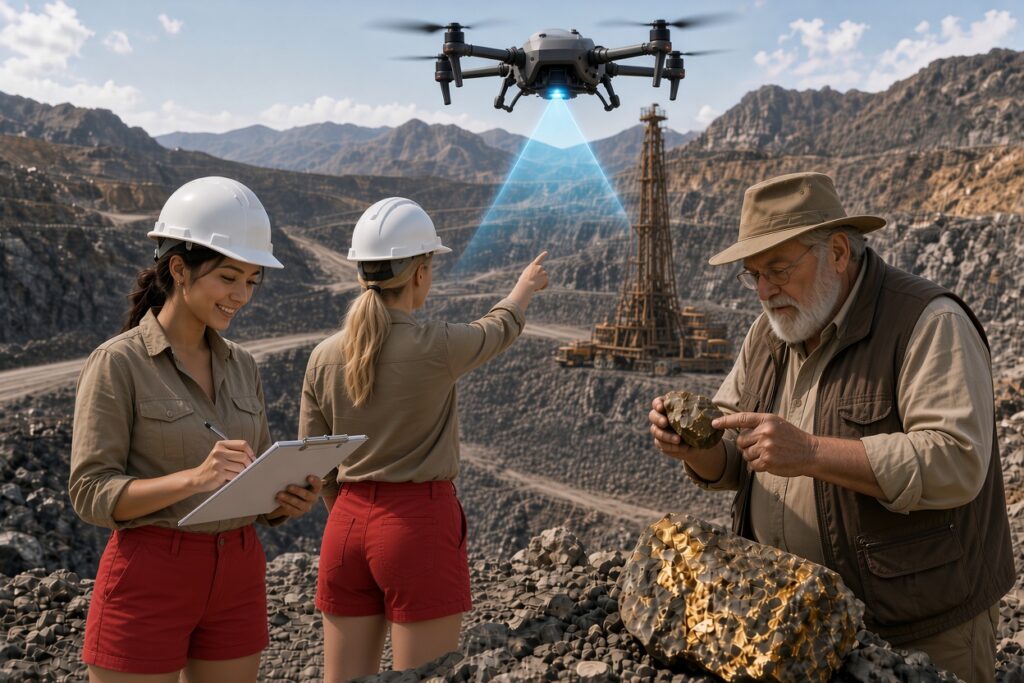
Unmanned aerial vehicles (drones) equipped with multispectral, hyperspectral, and LiDAR sensors have become essential tools. They can rapidly survey large areas, detect subtle alteration minerals associated with gold deposits (such as sericite, chlorite, or iron oxides), and create detailed 3D topographic models. Hyperspectral imaging from drones is particularly effective at mapping mineralogical variations on highwalls and outcrops that are difficult or dangerous for field teams to access.
Some companies are now combining AI agents with drone swarms and even quadruped robots for autonomous data collection, further reducing the need for extensive human fieldwork in remote or hazardous terrain.
Advanced Geophysical and Quantum Sensing
Traditional geophysical methods (magnetics, electromagnetics, gravity) continue to improve through higher-resolution sensors and better inversion algorithms. Emerging quantum technologies are particularly promising. Quantum gravimeters and magnetometers can detect extremely subtle density and magnetic variations underground, offering the potential to “see” deeper and more clearly than conventional instruments. Early field trials and industry investments (including by major mining companies) suggest these sensors will play an increasing role in the coming years.
Geochemical Advances
New laboratory and field methods, such as optimized aqua regia digestion combined with solid-phase extraction and machine-learning spatial modeling, allow more sensitive and reliable detection of gold in soil samples at very low concentrations. These techniques generate predictive distribution maps that guide targeted follow-up sampling and drilling.
Benefits and Outlook
The integration of these technologies offers several clear advantages:
- Dramatically shorter exploration timelines
- Higher success rates in target generation
- Reduced drilling costs and environmental footprint
- Better risk assessment before major capital investment
While field expertise and geological understanding remain essential, the modern gold explorer increasingly operates as a data scientist as much as a traditional geologist. The combination of AI, advanced sensors, drones, and quantum technologies is not merely improving efficiency—it is fundamentally changing how and where new gold resources are discovered.